How To Stop Intrusive Thoughts: CBT, ERP, And ACT Tools
That disturbing image that flashes through your mind. The "what if" thought that won't quit. The random, unsettling idea that makes you wonder what's wrong with you. If you're searching for how to stop intrusive thoughts, you're not alone, and you're not broken. These unwanted mental visitors show up for nearly everyone, but for some people, they stick around and cause real distress.
Here's what most people get wrong: trying to suppress or fight these thoughts usually makes them stronger. The harder you push them away, the more they push back. This is where evidence-based approaches like Cognitive Behavioral Therapy (CBT), Exposure and Response Prevention (ERP), and Acceptance and Commitment Therapy (ACT) offer a different path, one that actually works.
At Foothills CBT, our Boulder-based team specializes in these research-backed techniques for anxiety, OCD, and the kind of sticky thoughts that keep you up at night. This guide breaks down the practical tools and strategies that help our clients change their relationship with intrusive thoughts, so you can stop being hijacked by your own mind and start living with more freedom.
What intrusive thoughts are and why they stick
Intrusive thoughts are unwanted mental events that pop into your consciousness without permission. They can be images, impulses, or worries that feel disturbing, taboo, or completely out of character. A parent might suddenly picture their child getting hurt. Someone driving might imagine swerving into oncoming traffic. You might have a bizarre sexual or violent thought that makes you question your sanity or morality, even though these thoughts go against everything you value.
These thoughts are not predictions, desires, or signs of hidden impulses. Your brain generates thousands of thoughts daily, and some of them are bound to be weird, uncomfortable, or shocking. The difference between someone who experiences occasional odd thoughts and someone who suffers from intrusive thoughts is not the content of the thoughts themselves, but the meaning you attach to them and how much distress they cause.
The mental mechanics behind why they persist
Your brain has a threat detection system that evolved to keep you safe. When you have a thought that triggers alarm, your brain tags it as important information that needs attention. The problem starts when you react to the thought with fear, disgust, or panic. Your emotional reaction sends a signal that this thought is dangerous, which paradoxically makes your brain more likely to serve it up again.

Psychologist Daniel Wegner demonstrated this with his famous "white bear" experiment. When people try not to think about something, they think about it more. The act of suppression requires your brain to monitor for the forbidden thought, which means constantly checking if you're thinking it. This is why learning how to stop intrusive thoughts isn't about blocking or controlling them, but about changing how you respond when they show up.
The harder you work to push a thought away, the more central it becomes to your mental experience.
Why certain thoughts become "sticky"
Thoughts stick when they violate something you care deeply about. If you value being a good person, you're more vulnerable to morally repugnant intrusive thoughts. If you're responsible and safety-conscious, you'll get more "what if" thoughts about harm or danger. People with OCD experience this amplified. Their brains become hypervigilant to specific themes like contamination, symmetry, harm, or taboo subjects.
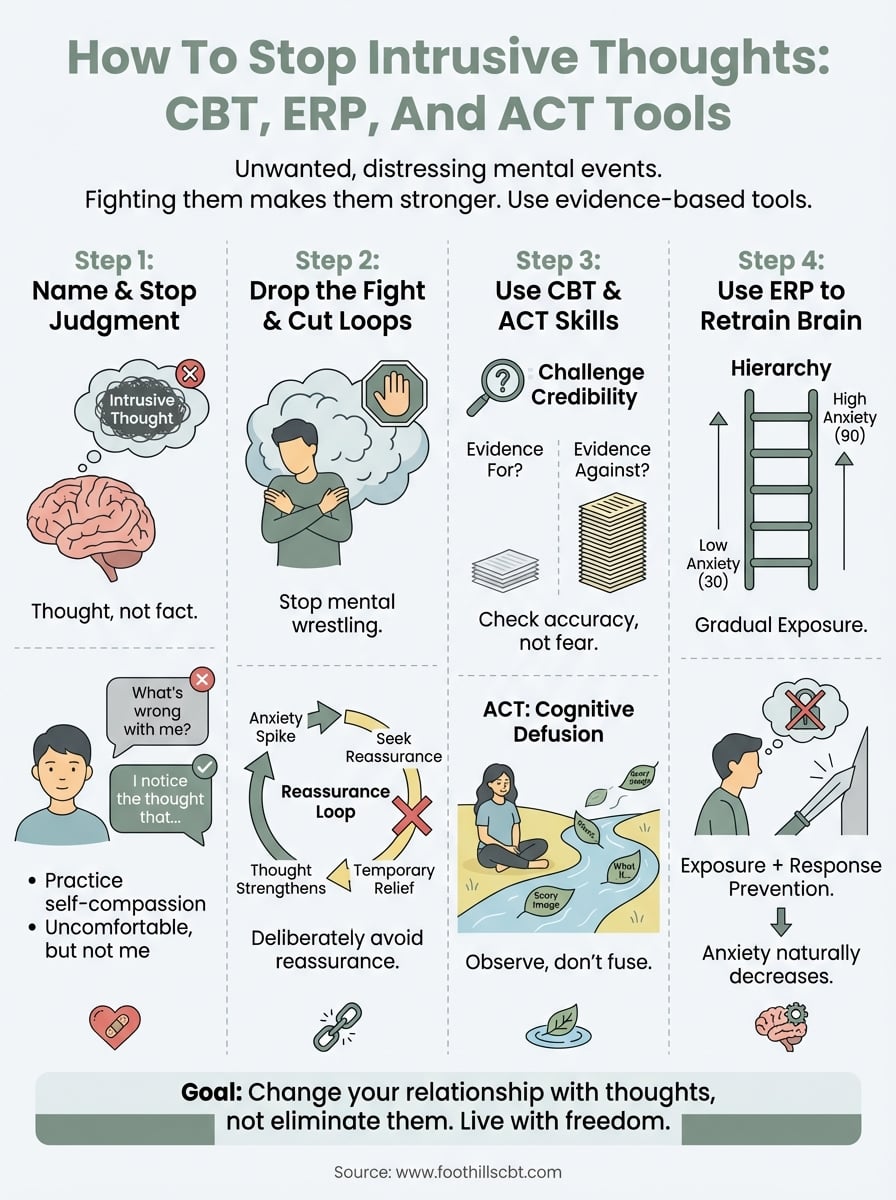
The stickiness intensifies through what therapists call reassurance-seeking loops. You have the thought, get anxious, then try to figure out if the thought means something bad about you. You might mentally review past behavior, ask others for reassurance, or perform rituals to "undo" the thought. Each time you engage in these behaviors, you teach your brain that the thought was genuinely threatening, which strengthens the neural pathway that produces it. Breaking this cycle requires specific skills from CBT, ACT, and ERP, which we'll cover in the steps ahead.
Step 1. Name the thought and stop self-judgment
The first step in learning how to stop intrusive thoughts is recognition without reaction. When an unwanted thought appears, your immediate task is to identify it as exactly what it is: a mental event, not a reflection of your character or desires. This sounds simple, but it's one of the most powerful cognitive shifts you can make. Instead of letting the thought spiral into panic or shame, you create distance by naming it.
Label it as a thought, not a fact
Your brain treats thoughts as urgent information when they trigger strong emotion. Breaking that pattern starts with precise labeling. When a disturbing image or worry appears, mentally say: "I'm having the thought that..." and complete the sentence with whatever showed up. For example, instead of "What if I hurt someone?" you reframe it as "I'm having the thought that I might hurt someone."
This simple prefix creates psychological distance. You shift from being inside the thought to observing it from outside. The thought becomes an object you can examine rather than a truth you must accept or disprove. A parent who has an intrusive image of their child falling might label it: "I'm noticing my brain generated a scary image about my child." This acknowledges the mental event without endorsing its content.
Thoughts are mental events, not facts. Labeling them as such removes their false authority.
Practice self-compassion language
Most people respond to intrusive thoughts with harsh self-criticism. "What's wrong with me?" or "I'm disgusting for thinking that" only adds emotional fuel to the original thought. Replace judgment with neutral observation. You might say internally: "This is an intrusive thought. They're uncomfortable but common."
Your internal dialogue matters. Use phrases that acknowledge difficulty without pathologizing yourself. Try these self-compassion statements when intrusive thoughts appear:
- "This thought is uncomfortable, but it doesn't define me"
- "My brain produced this content. I didn't choose it"
- "Having this thought doesn't make me a bad person"
- "This is anxiety talking, not reality"
These responses interrupt the shame spiral that makes thoughts stick and allows you to move toward more effective coping strategies in the steps ahead.
Step 2. Drop the fight and cut reassurance loops
The second step in learning how to stop intrusive thoughts is counterintuitive: stop trying to make them go away. Most people instinctively fight unwanted thoughts through mental gymnastics, logical analysis, or seeking proof that the thoughts don't mean anything. These efforts feel productive in the moment, but they actually feed the problem by reinforcing the idea that the thoughts are dangerous enough to warrant all this mental effort.
Recognize mental wrestling as the problem
When an intrusive thought appears, you might spend minutes or hours trying to neutralize it through reasoning. You replay conversations, analyze your feelings, or construct logical arguments for why the thought isn't true. This mental wrestling creates a paradox: the more you engage with the thought to disprove it, the more real estate it occupies in your mind.
Trying to solve, disprove, or mentally fight an intrusive thought gives it the attention and importance that makes it stick.
Your brain interprets all this mental activity as confirmation that the thought matters. Instead of wrestling, practice noticing and allowing. When the thought appears, acknowledge it exists without launching into analysis. You might say internally: "There's that thought again" and then redirect your attention to whatever you were doing. This response starves the thought of the engagement it needs to persist.
Stop reassurance-seeking behaviors
Reassurance-seeking is the invisible fuel that keeps intrusive thoughts alive. You might ask others if they think you're a bad person, Google whether having certain thoughts is normal, or mentally review past behavior to prove you're not capable of what the thought suggests. Each reassurance attempt temporarily reduces anxiety, which teaches your brain that the thought was genuinely threatening.
Break the reassurance loop by identifying your specific patterns:
- Asking family or friends "Do you think I would ever..."
- Searching online for similar thoughts or symptoms
- Mentally reviewing past actions to prove your character
- Checking locks, appliances, or other objects repeatedly
- Confessing thoughts to others to feel absolved
When you catch yourself seeking reassurance, deliberately choose not to. The anxiety will spike temporarily, but this is how you teach your brain that the thought isn't actually dangerous. Each time you resist reassurance, you weaken the thought's grip.
Step 3. Use CBT and ACT skills to unhook
Once you've named the thought and stopped fighting it, you need practical tools to change how these thoughts affect you. This is where evidence-based therapy techniques become your daily toolkit. Cognitive Behavioral Therapy (CBT) teaches you to examine the accuracy and usefulness of your thoughts, while Acceptance and Commitment Therapy (ACT) helps you change your relationship with them entirely. Both approaches are effective for learning how to stop intrusive thoughts from controlling your behavior.
Challenge the thought's credibility
CBT works by questioning whether your intrusive thoughts reflect reality or distorted thinking. When an anxious thought appears, ask yourself specific questions that reveal its logical flaws. What actual evidence supports this thought? What evidence contradicts it? If a friend had this thought, what would you tell them?
Create a simple thought record to practice this skill. Write down the intrusive thought, rate your anxiety level, identify any cognitive distortions (like catastrophizing or mind-reading), and then write a more balanced perspective. For example, if your thought is "I didn't lock the door and someone will break in," your balanced response might be "I usually check the door. Even if I forgot once, break-ins are statistically rare in my neighborhood."
Examining a thought's evidence base strips away its false authority and reduces its emotional impact.
Practice cognitive defusion
ACT takes a different approach by helping you separate yourself from your thoughts rather than debating their content. Defusion techniques create psychological distance without requiring you to change what the thought says. These methods work because they interrupt the automatic fusion between you and your mental content.

Try these defusion exercises when intrusive thoughts appear:
- Repeat the thought in a silly cartoon voice internally
- Visualize the thought as text scrolling across a screen
- Thank your brain: "Thanks, brain, for that thought"
- Add "I notice I'm having the thought that..." before it
- Imagine placing the thought on a leaf floating down a stream
Practice defusion regularly, not just during high-anxiety moments. The goal isn't to make thoughts disappear but to see them as mental noise rather than commands you must obey or threats you must neutralize.
Step 4. Use ERP to retrain your brain over time
Exposure and Response Prevention (ERP) is the gold-standard treatment for intrusive thoughts, particularly when they're connected to OCD or severe anxiety. Unlike the cognitive techniques in Step 3, ERP doesn't ask you to change what you think about thoughts. Instead, it systematically retrains your brain's threat response by exposing you to the feared thought or situation while preventing the compulsive or avoidance behaviors that usually follow. This process teaches your nervous system that the thought itself isn't dangerous.
Build an exposure hierarchy
Start by creating a ranked list of situations or thoughts that trigger your intrusive thoughts, ordered from least to most distressing. Rate each item on a scale of 0-100 based on how much anxiety it provokes. This hierarchy becomes your roadmap for gradual exposure.
Here's an example hierarchy for someone with harm-related intrusive thoughts:
| Anxiety Level | Exposure Situation |
|---|---|
| 30 | Hold a butter knife while chopping vegetables |
| 50 | Stand near a balcony railing without checking distance |
| 60 | Drive past a pedestrian without reviewing if you hit them |
| 75 | Watch a movie scene with violence without mental rituals |
| 90 | Allow the intrusive thought "What if I hurt someone?" without reassurance |
Begin with items rated 30-40 and work your way up gradually. You don't jump straight to the most distressing exposures. Progress happens through consistent practice at each level before advancing.
Practice exposure without response
Choose an item from your hierarchy and deliberately expose yourself to the triggering situation or thought. The critical part is preventing your usual response. If you normally seek reassurance, don't. If you mentally review whether you're capable of harm, stop yourself. If you avoid sharp objects, spend time near them.
Exposure without response prevention teaches your brain that anxiety decreases naturally without your compulsive behaviors.
Stay in the exposure situation until your anxiety drops by at least 50%. This might take 20 minutes or an hour. Repeat the same exposure multiple times across several days until it no longer triggers significant anxiety. Then move to the next item on your hierarchy. This systematic approach is how to stop intrusive thoughts from controlling your life through deliberate nervous system retraining.
Your plan from here
Learning how to stop intrusive thoughts requires consistent practice with the techniques outlined above. Start with Step 1 by naming your thoughts without judgment for at least one week. Once that becomes automatic, add Step 2 by identifying and cutting your reassurance loops. Layer in the CBT and ACT skills from Step 3 as daily tools, then gradually introduce ERP exposures when you're ready for structured retraining.
Progress isn't linear. You'll have days when thoughts feel louder or more distressing, and that's normal. The goal isn't to eliminate intrusive thoughts completely but to change your relationship with them so they no longer control your behavior or steal your peace of mind.
If intrusive thoughts continue disrupting your daily life despite practicing these skills, working with a therapist trained in evidence-based approaches makes a significant difference. Our team at Foothills CBT specializes in CBT, ACT, and ERP for anxiety, OCD, and intrusive thoughts throughout Colorado. We help people move from being controlled by their thoughts to living with freedom.