What Is Emotion Regulation? Skills, Models, And Why It Matters
You've felt it before, a wave of frustration that makes you snap at someone you love, or anxiety that keeps you awake long after you should be asleep. These moments raise a fundamental question: what is emotion regulation, and why do some people seem to navigate emotional storms with relative ease while others feel swept away? Understanding how we manage our internal experiences is one of the most practical skills anyone can develop for their mental health.
At Foothills CBT, we work with clients throughout Colorado who struggle with overwhelming emotions, from anxiety and sadness to the shame and anger. What we see repeatedly in our Boulder practice is that emotion regulation isn't about suppressing feelings or pretending everything is fine. It's about building specific, learnable skills that help you respond to difficult emotions rather than react to them.
This article breaks down emotion regulation: what it actually means, the psychological models that explain it, and evidence-based strategies you can begin applying in your daily life. Whether you're navigating anxiety, depression, or simply want more steadiness in your emotional responses, understanding these concepts gives you a foundation for real change.
Why emotion regulation matters for mental health
Your ability to manage emotions shapes every aspect of your mental health. When emotion regulation is difficult, vulnerability to anxiety disorders, depression, and other clinical conditions increases significantly. Research consistently shows that emotional dysregulation serves as both a symptom and a contributing factor across nearly every mental health condition we treat.
The ripple effect on daily functioning
Emotional dysregulation doesn't just affect how you feel in the moment -- it shapes relationships, work performance, and physical health in ways that aren't always easy to recognize. When difficult emotions are hard to process, it's common to turn to avoidance behaviors like substance use, excessive social media, or withdrawing from meaningful activities. These short-term strategies often create long-term problems that compound the original difficulty.
People with strong emotion regulation skills make better decisions under pressure, maintain healthier relationships, and recover more quickly from setbacks. They don't experience fewer negative emotions, they've learned to navigate those emotions without letting them dictate behavior. This distinction matters enormously when facing chronic stress, major life transitions, or traumatic experiences.
Understanding emotion regulation reveals why some people bounce back from emotional challenges while others get caught in patterns of reactivity.
The connection to specific mental health conditions
Emotion regulation difficulties show up differently depending on the diagnosis. With generalized anxiety, the struggle to tolerate uncertainty often drives chronic worry and safety behaviors that inadvertently maintain it. With depression, accessing positive emotions can feel out of reach, and attention tends to get pulled toward negative experiences and held there.
Panic disorder often involves fear of emotional responses themselves, creating a cycle where anxiety about having a panic attack triggers the very symptoms you're trying to avoid. With OCD, difficulty tolerating the distress of intrusive thoughts fuels compulsive behaviors. Post-traumatic stress reactions frequently stem from overwhelming emotions the nervous system couldn't fully process at the time of a traumatic event.
Borderline personality disorder represents perhaps the clearest example; intense emotional reactivity and difficulty returning to baseline create significant impairment across all areas of life. Conditions like eating disorders and substance use disorders also frequently have emotional dysregulation at their core. Understanding these connections helps explain why strengthening emotion regulation skills often produces improvements across multiple symptoms at once.
How emotion regulation works in the brain and body

Understanding emotion regulation starts with knowing how the brain and nervous system actually process emotional experiences. Emotions don't just happen in the mind -- they involve coordinated activity across multiple brain regions and generate physical sensations throughout the body. This biological reality explains why emotional responses feel so powerful and, at times, so difficult to manage.
The prefrontal cortex's role in managing emotions
The prefrontal cortex acts as the brain's control center for emotion regulation. Sitting just behind the forehead, it handles executive functions like planning, decision-making, and impulse control. When a difficult emotion is successfully managed, the prefrontal cortex is actively moderating signals from deeper brain structures.
The amygdala, located deep in the brain's temporal lobe, detects potential threats and triggers emotional reactions before the conscious mind even recognizes what's happening. This explains why anxiety or anger can arise before there's any clear understanding of why. Effective emotion regulation depends on communication between the prefrontal cortex and the amygdala. Essentially, the thinking brain signaling to the reactive brain when a perceived threat doesn't require a full stress response.
Your nervous system's automatic responses
When a strong emotion arises, the autonomic nervous system shifts into gear. The sympathetic nervous system activates the fight-or-flight response, increasing heart rate, blood pressure, and breathing rate. These physical changes prepare the body for action -- but can feel overwhelming when triggered by non-life-threatening situations like social anxiety or work stress.
The parasympathetic nervous system serves the opposite function, helping the body return to a calm baseline. People with strong emotion regulation skills can activate this system more quickly through techniques like diaphragmatic breathing or progressive muscle relaxation. This is precisely why body-focused strategies often work better than simply trying to "think differently" when emotionally activated.
Common emotion regulation models and terms
Psychologists have developed several frameworks to explain how emotion regulation works, including models central to therapies like Dialectical Behavior Therapy (DBT). These frameworks break the process into specific stages and strategies, giving both clients and clinicians precise language for understanding where difficulties arise and where intervention can help most.
The DBT Biosocial Model of Emotion Regulation
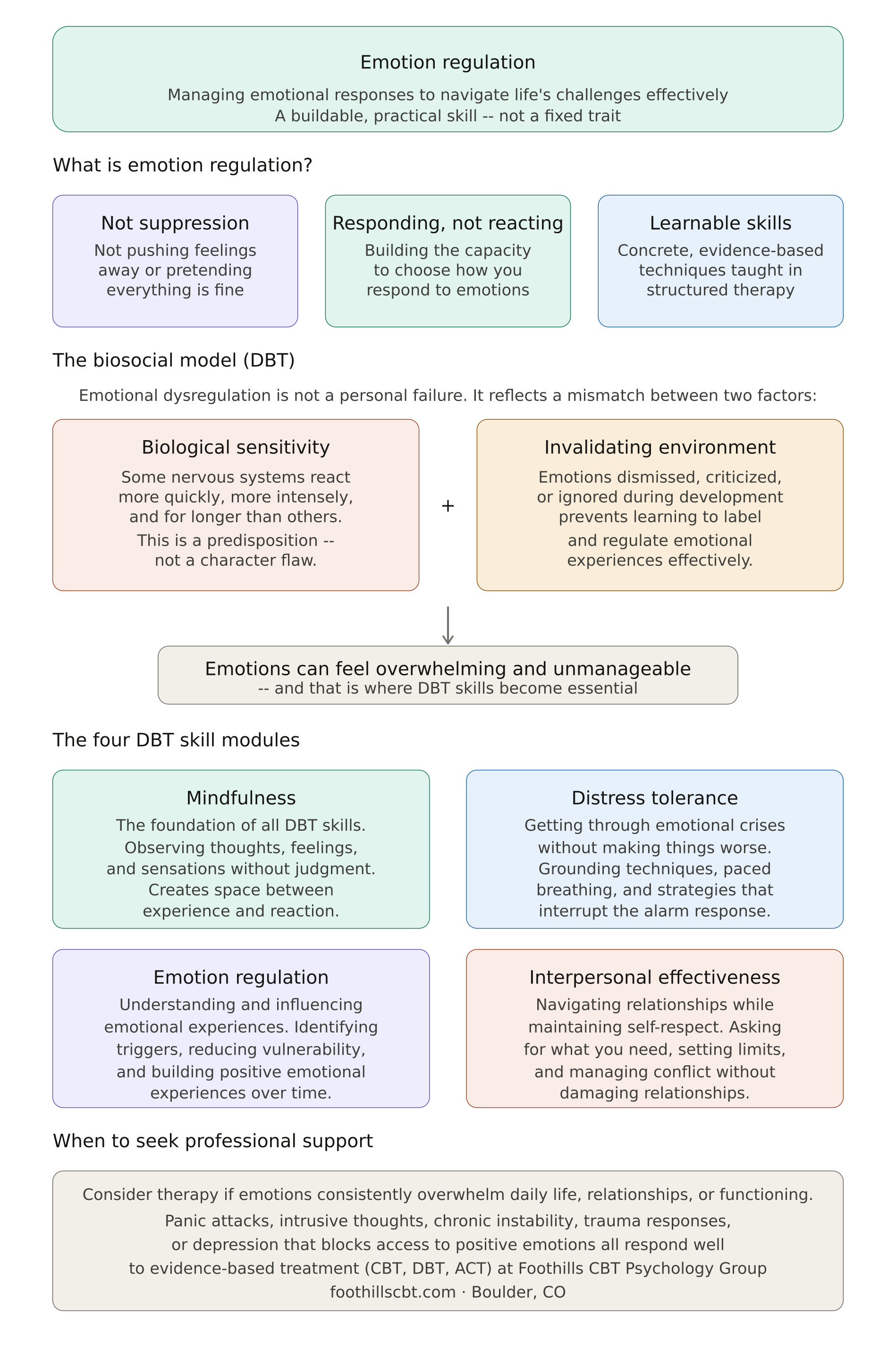
Dialectical Behavior Therapy (DBT) offers another widely used framework for understanding emotion regulation, particularly for people who experience emotions intensely. Developed by psychologist Marsha Linehan, PhD, the biosocial model explains emotional dysregulation as the result of two interacting factors: biological sensitivity and an invalidating environment.
In this model, some people are born with nervous systems that react more strongly to emotional stimuli. They may experience emotions more quickly, more intensely, and for longer periods than others. This heightened sensitivity isn't a flaw or a character weakness -- it's a biological predisposition that shapes how the brain and body respond to emotional situations.
The second factor involves the environment a person grows up in. An invalidating environment is one where emotional experiences are dismissed, criticized, or misunderstood -- being told "you're overreacting," "you shouldn't feel that way," or having emotions ignored altogether. Over time, this can prevent someone from learning to understand, label, and regulate their emotions effectively.
When high emotional sensitivity combines with limited opportunities to learn regulation skills, emotions can feel overwhelming and unmanageable. This is where DBT skills become essential.
The biosocial model is clear on one point: emotional dysregulation is not a personal failure. It reflects a mismatch between a sensitive nervous system and an environment that did not support the development of effective coping strategies.
DBT addresses this by teaching concrete skills in four areas:
Mindfulness, which helps you observe emotions without becoming overwhelmed by them and develop grounding techniques
Distress tolerance, which allows you to survive emotional crises without making situations worse
Emotion regulation, which teaches strategies for reducing vulnerability to intense emotions
Interpersonal effectiveness, which improves communication and relationship stability
Understanding the biosocial model can help people approach their emotional experiences with more compassion and curiosity rather than self-criticism. Instead of asking “What’s wrong with me?” the question becomes “What skills do I need to navigate these emotions more effectively?”
Understanding the biosocial model can be genuinely freeing. Rather than asking "What's wrong with me?" the question becomes "What skills do I need to navigate these emotions more effectively?" This shift -- from self-criticism to curiosity -- is not just a reframe. It reflects something true: intense emotional experiences are not evidence of weakness or failure. They are often the understandable result of a sensitive nervous system doing exactly what it was shaped to do.
Key terms in emotion regulation research
A few technical terms come up frequently in the emotion regulation literature and are worth knowing. Adaptive regulation refers to strategies that serve long-term wellbeing, while maladaptive regulation describes approaches that provide short-term relief but create problems over time. Suppression, for instance, means pushing down emotional expression without processing the underlying feeling.
Cognitive reappraisal involves changing how you interpret a situation in order to shift how you feel about it, and consistently shows the strongest outcomes in research. Distress tolerance refers to the ability to withstand difficult emotions without making them worse. The window of tolerance describes the optimal zone of arousal in which emotions can be processed effectively; neither overwhelmed nor shut down. Nervous system regulation and self-regulation are broader terms describing the overall capacity to move fluidly between emotional states and return to baseline after activation.
Skills that strengthen emotion regulation
Understanding emotion regulation matters most when it translates into specific, trainable skills you can apply in daily life. These aren't vague suggestions about "staying positive" or "thinking differently". They are concrete techniques backed by decades of research and taught in structured treatment programs. Many of these skills can be practiced independently, though working with a psychologist accelerates progress and helps identify which strategies fit your specific challenges.
Mindfulness and awareness practices
Building awareness of your emotional state is the foundation of all regulation skills. You can't manage what you don't notice, which is why mindfulness appears in nearly every evidence-based therapy protocol. Mindfulness means observing thoughts, feelings, and physical sensations without immediately judging or reacting to them. This ability to observe emotions without being controlled by them creates space between experience and reaction, and that space is where regulation happens.
A simple starting point is checking in with yourself several times throughout the day. Notice where emotions live in the body: tension in the jaw, heaviness in the chest, a knot in the stomach. Name the specific emotion rather than settling for vague labels like "bad" or "stressed." The more precisely you can identify what you're feeling, the better positioned you are to choose a response that actually fits.
Grounding techniques can work quickly when anxiety or anger spike. Focusing on physical sensations, like the feeling of your feet on the floor, the temperature of the air, the sounds in the room, can interrupt the brain's alarm response and bring attention back to the present moment.
Distress tolerance techniques
Sometimes the most important skill is managing intense emotions when you can't immediately change the situation causing them. Distress tolerance techniques help you get through emotional crises without making things worse through impulsive actions you'll regret later. These strategies don't solve the underlying problem, but they prevent additional problems from forming while you're overwhelmed.
Other effective techniques include paced breathing that extends the exhale, progressive muscle relaxation, and sensory experiences that demand your full attention.
When emotion regulation feels impossible
Practicing these skills consistently and still feeling overwhelmed doesn't mean something is fundamentally wrong or that emotion regulation won't work for you. It often means there are underlying conditions that respond best to professional support -- and recognizing that is itself an important form of self-awareness.
Signs you need professional support
Certain patterns suggest that professional support would serve you better than managing alone. Panic attacksthat interfere with daily activities, intrusive thoughts that won't resolve, or emotional reactions intense enough to damage relationships are all signs that structured therapy has moved from helpful to necessary.
Depression that blocks access to positive emotions, trauma responses triggered by seemingly minor events, or chronic emotional instability that keeps you in crisis. These are conditions that respond best to evidence-based treatment, not self-directed skill practice alone. Recognizing these patterns is itself a meaningful step toward getting the right kind of help.
Professional therapy isn't a sign that you've failed at managing emotions. It's a sign that you're ready to address the underlying causes that make regulation so difficult in the first place.
How therapy addresses regulation difficulties
Psychologists trained in cognitive behavioral approachescan identify exactly where emotion regulation breaks down and teach targeted skills matched to your specific needs. Dialectical Behavior Therapy (DBT) builds regulation through structured skill modules, Cognitive Behavioral Therapy (CBT) addresses the thought patterns that intensify emotional responses, and Acceptance and Commitment Therapy (ACT) develops psychological flexibility when rigid attempts at emotional control make things worse.
Working with a therapist provides real-time feedback on regulation attempts and a safe environment to practice new skills before applying them to more challenging situations -- accelerating progress in ways that self-directed effort alone rarely achieves.
Working with a therapist gives you real-time feedback on your regulation attempts and helps you practice new skills in a safe environment before applying them to challenging situations. This personalized guidance accelerates your progress far beyond what most people achieve through self-directed efforts alone.
Next steps for feeling more in control
You now understand what is emotion regulation means and why these skills matter for your mental health. The strategies outlined here give you concrete starting points for managing difficult emotions more effectively. Start by practicing one or two techniques consistently rather than trying to implement everything at once. Small, regular practice builds regulation capacity better than sporadic, intense efforts.
If you're in Colorado and struggling with anxiety, depression, trauma responses, or other emotional challenges that interfere with your daily life, consider working with a therapist who specializes in evidence-based treatments. At Foothills CBT, our team uses research-backed approaches like CBT, DBT, and ACT to help clients throughout the state develop stronger emotion regulation skills. We offer both in-person sessions in Boulder and telehealth appointments, making it easier to access the specialized support you need to feel more in control of your emotional experiences.