10 Evidence-Based Stress Management Techniques That Work
Stress isn't just uncomfortable, it changes how you think, sleep, and function. When it becomes chronic, it can fuel anxiety, depression, and physical health problems. The good news? Effective stress management techniques exist, and they're backed by research. You don't have to white-knuckle your way through overwhelming days or hope things eventually get better on their own. Specific, learnable skills can help you regain control.
At Foothills CBT, we specialize in cognitive and behavioral therapies that are grounded in clinical research. Our team of PhD-level psychologists works with clients across Colorado who are dealing with anxiety, depression, and the kind of persistent stress that disrupts daily life. We've seen firsthand how evidence-based approaches create real, measurable change, not just temporary relief, but lasting improvements in how people respond to pressure.
This article covers ten stress management techniques that actually work, according to the research. You'll find practical strategies you can start using immediately, along with approaches that build resilience over time. Whether you're managing work pressure, navigating a difficult transition, or simply feeling stuck, these tools offer a clear path forward. Let's get into what the evidence says.
1. Work with a CBT therapist for stress skills
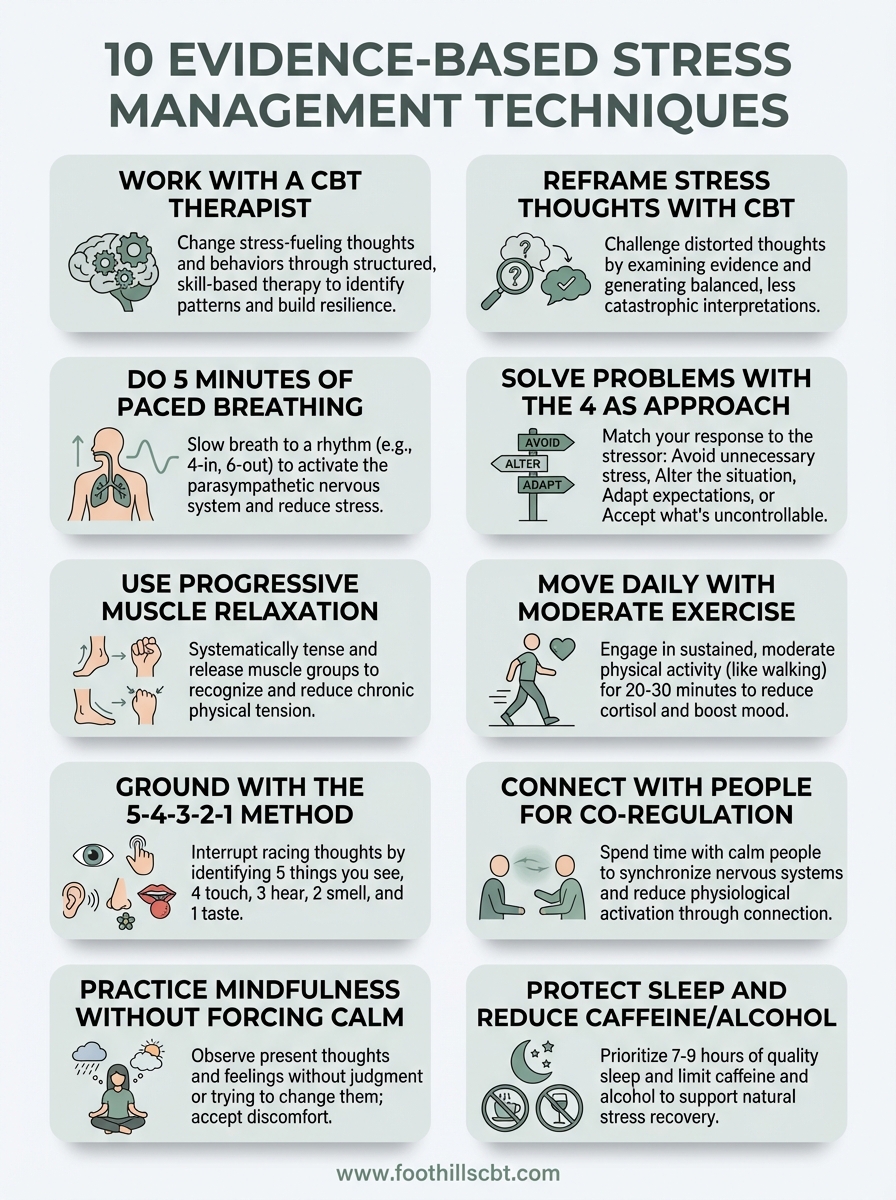
Cognitive Behavioral Therapy (CBT) isn't just talk therapy. It's a structured, skill-based approach that teaches you how to change the thoughts and behaviors that keep stress high. Instead of venting about problems week after week, you work with a therapist to identify specific patterns that fuel your stress response and learn practical tools to interrupt them. Sessions focus on building competencies you can use outside the therapy room, not just processing emotions in the moment.
What it is
CBT for stress gives you a personalized roadmap for managing overwhelm based on your unique triggers and responses. Your therapist helps you understand how your thoughts, physical sensations, and behaviors interact to create or reduce stress. You learn to spot cognitive distortions like catastrophizing or all-or-nothing thinking that amplify pressure, and you practice alternative ways of interpreting situations. The approach is collaborative, time-limited, and goal-focused, which means you're working toward measurable change from the first session.
Research shows that CBT produces lasting improvements in stress management, with benefits that continue long after therapy ends.
How to do it
Start by finding a licensed therapist trained in CBT who works with stress-related concerns. At your first session, you'll identify specific stressors and set clear goals for what you want to change. Between sessions, you'll complete homework assignments that help you practice new skills in real situations, like thought records, behavioral experiments, or exposure exercises. Your therapist will adjust the approach based on what's working and what needs refinement. Sessions typically occur weekly and last 50 minutes, with most people seeing significant progress within 12 to 16 weeks.
When it helps most
CBT works best when stress has become chronic or unmanageable on your own. If you're stuck in thought loops, avoiding important activities, or noticing physical symptoms like headaches or insomnia, working with a therapist gives you the structure to break those patterns. It's particularly effective if you're dealing with multiple stressors at once or if past attempts at stress management techniques haven't created lasting change. You don't have to wait until you're in crisis; CBT builds skills that prevent stress from escalating in the first place.
2. Do 5 minutes of paced breathing
Your body interprets rapid, shallow breathing as a sign of danger, which triggers your stress response even when you're physically safe. Paced breathing reverses this process by activating your parasympathetic nervous system, the part of your body responsible for rest and recovery. This is one of the most accessible stress management techniques because it works immediately and requires no equipment. You can use it anywhere, from your desk to a crowded subway car, and see measurable changes in heart rate and cortisol within minutes.

What it is
Paced breathing involves slowing your breath to a specific rhythm that signals safety to your nervous system. You inhale for a count of four, hold briefly, and exhale for a count of six or longer. The extended exhale is what creates the calming effect by stimulating the vagus nerve. This isn't about taking deep breaths or forcing your lungs to capacity. Instead, you focus on breathing at a rate of around five to six breaths per minute, which research shows optimizes heart rate variability and reduces stress hormones.
Slowing your exhale to longer than your inhale activates the body's natural relaxation response.
How to do it
Sit comfortably and place one hand on your chest, the other on your belly. Breathe in through your nose for four counts, feeling your belly expand rather than your chest. Pause for two counts. Exhale slowly through your mouth for six to eight counts, letting all the air release. Repeat this cycle for five minutes, keeping your attention on the counting and the physical sensations of breathing. If your mind wanders, that's normal. Just redirect your focus back to the count.
When it helps most
Use paced breathing when you notice physical stress symptoms like tension, racing heart, or shallow breathing. It works particularly well before high-pressure situations like presentations or difficult conversations, and it can interrupt panic symptoms before they escalate. You can also practice it proactively at the same time each day to build your body's baseline stress resilience.
3. Use progressive muscle relaxation
Progressive muscle relaxation (PMR) targets the physical tension that accumulates in your body during stress. Instead of trying to relax by thinking calm thoughts, you deliberately tense specific muscle groups and then release them, which teaches your body to recognize and reduce chronic tightness. This technique was developed in the 1930s and remains one of the most researched stress management techniques for good reason: it creates measurable reductions in muscle tension, blood pressure, and anxiety symptoms within a single session.
What it is
PMR works by having you systematically contract and release muscle groups throughout your body, typically starting from your feet and moving upward. You tense each muscle group for about five seconds, then release the tension and notice the difference in sensation for 10 to 15 seconds before moving to the next area. The contrast between tension and relaxation trains your awareness of where you hold stress physically, which helps you catch and release it earlier in daily life.
Learning to recognize muscle tension helps you interrupt your stress response before it escalates.
How to do it
Sit or lie in a quiet space where you won't be interrupted. Start with your feet: curl your toes tightly for five seconds, then release completely and notice the warm, heavy sensation for 10 seconds. Move to your calves, thighs, buttocks, stomach, chest, hands, arms, shoulders, neck, and face, tensing and releasing each area. Complete the full body cycle takes about 15 minutes. Focus on the physical sensations rather than trying to force relaxation.
When it helps most
Use PMR when stress creates physical symptoms like headaches, jaw clenching, or back pain. It works particularly well before bed if tension interferes with sleep, and it helps after high-stress events when your body stays activated even though the situation has passed. Regular practice makes you more aware of tension patterns throughout your day.
4. Ground yourself with the 5-4-3-2-1 method
The 5-4-3-2-1 technique pulls your attention away from racing thoughts and anchors it in the present moment through your five senses. When stress triggers your mind to spiral into worries about the future or rumination about the past, this method interrupts that pattern by forcing your brain to focus on immediate sensory input. You engage your observational skills rather than your emotional reactions, which creates distance from overwhelming feelings and helps you regain control.

What it is
This grounding exercise asks you to identify five things you see, four things you can touch, three things you hear, two things you smell, and one thing you taste. The descending number pattern keeps your mind occupied with a concrete task instead of abstract worries. Unlike other stress management techniques that require training or preparation, this method works immediately because your senses are always available to you.
Focusing on sensory details in your environment interrupts your stress response by shifting attention away from internal worry.
How to do it
Start by naming five things you see in your environment, describing each one specifically. Touch four objects around you, noticing their texture and temperature. Listen for three distinct sounds, even subtle ones like your breath or distant traffic. Identify two scents, which might require moving to find them. Finally, notice one taste in your mouth. Speak these observations out loud or think them deliberately, taking your time with each sensory category.
When it helps most
Use the 5-4-3-2-1 method when anxious thoughts loop repeatedly or when you feel disconnected from your body during stress. It works particularly well during panic attacks, before anxiety-provoking situations, or when you catch yourself catastrophizing. The technique requires no special setting, which makes it practical for high-pressure moments at work, in social situations, or anywhere you need immediate relief.
5. Practice mindfulness without forcing calm
Mindfulness differs from most stress management techniques because the goal isn't to feel better immediately. Instead, you learn to observe your stress without trying to change it, fix it, or push it away. This approach sounds counterintuitive, but research shows that accepting discomfort reduces its intensity more effectively than fighting it. When you stop battling your stress response, you create space to respond skillfully rather than react automatically.
What it is
Mindfulness involves paying attention to present-moment experience without judgment. You notice thoughts, feelings, and physical sensations as they arise, acknowledging them without labeling them as good or bad. This isn't meditation that requires clearing your mind or achieving a relaxed state. Instead, you observe stress as a temporary experience, like watching clouds pass through the sky. The practice builds your capacity to stay present even when discomfort shows up.
Accepting stress as a temporary experience reduces its power over your behavior and mood.
How to do it
Set a timer for five minutes and sit comfortably. Notice whatever sensations exist in your body right now, including tension or discomfort. When thoughts appear, acknowledge them as "thinking" without following the thought thread. If emotions surface, name them silently: "This is anxiety" or "This is frustration." Return your attention to your breath or body sensations whenever you drift into analysis or problem-solving. The practice involves noticing you've wandered and gently redirecting your focus, not maintaining perfect concentration.
When it helps most
Use mindfulness when stress triggers avoidance behaviors or when you notice yourself trying to control uncontrollable situations. It works particularly well for persistent worries that don't respond to problem-solving and for emotional reactivity that creates secondary stress about your stress. Regular practice builds your tolerance for discomfort, which prevents minor stressors from escalating into overwhelming experiences.
6. Reframe stress thoughts with CBT
Cognitive reframing helps you identify and challenge the distorted thoughts that amplify stress. Your interpretation of events matters more than the events themselves, and CBT provides a structured method for questioning automatic negative thoughts that trigger your stress response. When you learn to spot patterns like catastrophizing, mind-reading, or all-or-nothing thinking, you create space to evaluate situations more accurately.
What it is
Reframing involves examining the evidence for and against your stress-inducing thoughts rather than accepting them as facts. You identify the specific thought creating distress, evaluate whether it's accurate or helpful, and generate alternative interpretations that better fit reality. This isn't positive thinking or pretending problems don't exist. Instead, you practice thinking more flexibly and accurately about challenging situations.
Questioning your automatic thoughts reduces their emotional impact and helps you respond more effectively to stressors.
How to do it
Write down the specific thought creating stress. Ask yourself what evidence supports this thought and what evidence contradicts it. Consider how someone else might view the same situation. Generate at least two alternative explanations that account for the facts without catastrophizing. Practice replacing the original thought with a more balanced interpretation when you notice it recurring. This process becomes faster with repetition.
When it helps most
Use cognitive reframing when stress thoughts feel overwhelming or paralyzing. It works particularly well for repetitive worries about future events, self-critical thoughts that fuel anxiety, or situations where your emotional reaction seems disproportionate to what actually happened. Regular practice makes this one of the most versatile stress management techniques.
7. Solve problems with the 4 As approach
Not every stressor requires the same response. Some situations demand direct action, while others need acceptance or a strategic withdrawal. The 4 As approach gives you a decision framework for matching your response to the actual demands of each stressor. This method prevents you from wasting energy fighting battles you can't win or accepting situations you could actually change. Instead of reacting impulsively or feeling paralyzed by overwhelm, you evaluate which strategy fits best.
What it is
The 4 As stand for Avoid, Alter, Adapt, and Accept. Avoid means stepping away from unnecessary stressors by setting boundaries or declining commitments. Alter involves changing the situation directly through communication or problem-solving. Adapt refers to adjusting your expectations or perspective about circumstances you can't change. Accept means acknowledging reality when a situation truly lies outside your control. Each approach serves different circumstances, and choosing the right one reduces the emotional toll stress creates.
Matching your response strategy to the type of stressor you face prevents wasted energy and chronic frustration.
How to do it
Start by identifying a specific stressor. Ask yourself if you can remove this stressor from your life entirely (Avoid). If not, consider whether you can change aspects of the situation through direct action (Alter). When the situation itself won't budge, evaluate if you can shift your expectations or interpretation (Adapt). Finally, if none of these options apply, practice accepting what you cannot control (Accept). Write down which approach fits and take one concrete step in that direction.
When it helps most
Use this framework when you feel stuck or when your current stress management techniques aren't creating change. It works particularly well for ongoing stressors like difficult relationships, workplace conflicts, or chronic health concerns. The 4 As help you stop cycling through ineffective responses and identify which specific action will actually reduce your stress load.
8. Move daily with moderate exercise
Physical activity changes your brain chemistry in ways that reduce stress hormones and boost mood-regulating neurotransmitters. You don't need intense workouts or gym memberships to get these benefits. Moderate exercise, the kind that gets your heart rate up but still lets you hold a conversation, creates measurable reductions in cortisol levels and anxiety symptoms. Among stress management techniques, movement stands out because it addresses both the physical and psychological components of stress simultaneously.

What it is
Moderate exercise includes activities like brisk walking, cycling, swimming, or light jogging where your effort level feels sustainable for 20 to 30 minutes. Research shows that consistent movement at this intensity produces more reliable stress reduction than occasional high-intensity sessions. The key lies in regularity rather than pushing yourself to exhaustion. Your body releases endorphins during sustained activity, while repetitive movements like walking or swimming create a meditative effect that quiets racing thoughts.
Regular moderate exercise reduces baseline cortisol levels and increases your resilience to future stressors.
How to do it
Start with 20 minutes of movement you actually enjoy. Walk outside, bike around your neighborhood, swim laps, or follow a beginner exercise video. Schedule it at the same time daily so it becomes automatic rather than a decision you debate. Track your consistency rather than intensity. If 20 minutes feels impossible, begin with 10 and add time gradually. The goal involves building a sustainable habit, not achieving fitness milestones.
When it helps most
Use daily movement when stress creates physical restlessness or when your mind loops through worries. Exercise works particularly well for chronic stress that builds throughout your day and for situations where you feel powerless or stuck. Morning movement sets your baseline stress response lower for the entire day, while evening exercise helps discharge tension before sleep.
9. Connect with people for co-regulation
Your nervous system doesn't regulate stress in isolation. When you spend time with calm, regulated people, their physiological state influences yours through co-regulation. This happens through unconscious cues like tone of voice, facial expressions, and body language. Unlike other stress management techniques that you practice alone, co-regulation leverages your biology's capacity to sync with others, creating calming effects that solo efforts can't match.
What it is
Co-regulation refers to the way your autonomic nervous system responds to the emotional state of people around you. When you interact with someone who feels grounded, their calm state signals safety to your body, which reduces cortisol and slows your heart rate. This isn't about venting or seeking advice. You benefit from being present with someone whose nervous system operates in a regulated state, which helps yours shift out of high alert.
Your body naturally syncs with the emotional state of people you spend time with.
How to do it
Identify people who stay relatively calm under pressure and whose presence feels settling. Reach out when stress runs high, even if you don't discuss your stressors. Spend time together in person when possible, as physical proximity strengthens co-regulation effects. Focus on genuine connection rather than problem-solving. Simple activities like having coffee, walking, or sitting together create conditions for your nervous systems to sync.
When it helps most
Use connection when stress creates isolation or overwhelm that solo techniques don't resolve. Co-regulation works particularly well after difficult events when your body stays activated, during chronic stress that depletes your emotional resources, or when anxiety makes you withdraw. Regular social connection builds baseline resilience against future stressors.
10. Protect sleep and reduce caffeine and alcohol
Poor sleep and substance use create a cycle that keeps your stress response chronically elevated. When you don't get adequate rest, your body produces more cortisol and your brain struggles to regulate emotions. Caffeine and alcohol compound this problem by disrupting sleep architecture and increasing physiological activation. This makes sleep hygiene and substance moderation essential stress management techniques, not optional lifestyle choices.
What it is
Sleep protection involves creating conditions that support seven to nine hours of quality rest each night. Your brain clears stress hormones during deep sleep, and inadequate rest prevents this recovery process. Caffeine blocks adenosine receptors that signal sleepiness, keeping your nervous system activated for up to six hours after consumption. Alcohol might make you drowsy initially, but it fragments sleep cycles and prevents restorative deep sleep. Managing both substances helps your body maintain its natural stress recovery mechanisms.
Sleep deprivation amplifies your stress response by preventing your brain from clearing cortisol and processing emotions.
How to do it
Set a consistent sleep and wake time, including weekends. Stop caffeine intake at least eight hours before bed, which typically means cutting off by early afternoon. Limit alcohol to one drink with dinner, consumed at least three hours before sleep. Create a dark, cool bedroom environment and remove screens 30 minutes before bed. If sleep problems persist beyond two weeks of consistent habits, track your patterns and consult a healthcare provider.
When it helps most
Prioritize sleep changes when stress creates irritability, emotional reactivity, or physical exhaustion. This approach works particularly well when other techniques provide temporary relief but stress keeps returning. Poor sleep undermines every other stress management strategy you try, which makes this a foundational intervention rather than an optional add-on.
Next steps
These stress management techniques work because they target different aspects of your stress response. Some create immediate relief through physical changes, while others build long-term resilience by changing how you think and respond to pressure. You don't need to master all ten at once. Start with one or two that address your most pressing stress symptoms, practice them consistently, and add more as needed.
Progress happens when you apply these skills in real situations, not just when you feel calm. The techniques that feel most uncomfortable often create the biggest changes because they interrupt patterns you've relied on for years. Give yourself time to build competence before judging whether something works.
If stress continues disrupting your sleep, relationships, or daily functioning despite using these approaches, working with a trained therapist accelerates your progress. The psychologists at Foothills CBT specialize in evidence-based treatment for stress, anxiety, and related concerns throughout Colorado. Professional guidance helps you identify specific patterns maintaining your stress and build customized skills that create lasting change.