What Is Dialectical Behavior Therapy? Skills And Uses Of DBT
If you've struggled with intense emotions that feel impossible to manage, or relationships that seem to fall apart despite your best efforts, you're not alone. What is dialectical behavior therapy? It's a structured, evidence-based treatment originally developed for people with borderline personality disorder, but it has since proven effective for a much wider range of emotional challenges, from depression and anxiety to eating disorders and chronic suicidal thoughts.
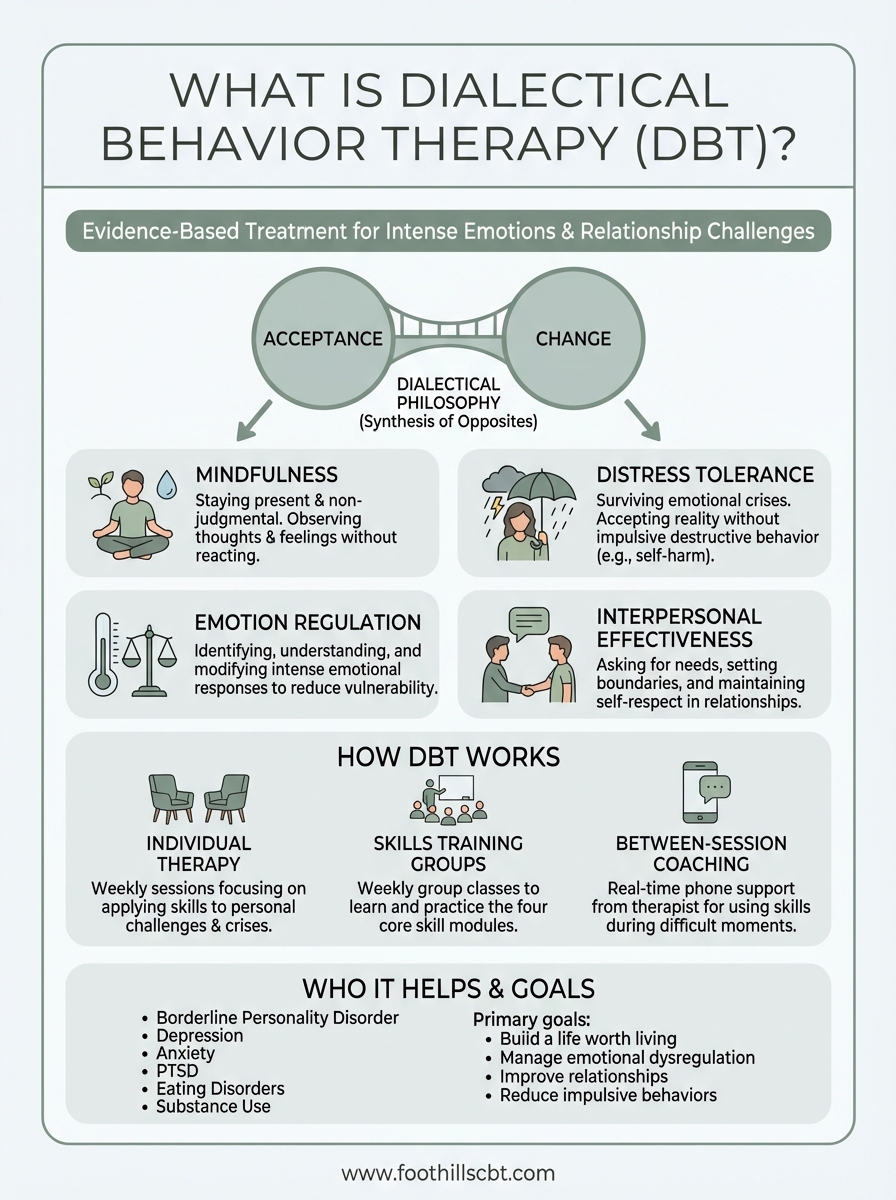
DBT stands apart because it combines acceptance strategies with change-focused techniques. Rather than asking you to simply think differently about your problems, DBT teaches concrete skills you can use in real-life situations. These skills fall into four core modules, mindfulness, distress tolerance, emotion regulation, and interpersonal effectiveness, each designed to help you build a life that feels meaningful.
At Foothills CBT, our clinicians in Boulder, Colorado use DBT as one of several evidence-based approaches to help clients manage difficult emotions and strengthen their relationships. This guide covers everything you need to know: how DBT works, what conditions it treats, the skills you'll learn, and how it compares to traditional cognitive behavioral therapy.
Why DBT matters for intense emotions
You might experience emotions that hit like a tidal wave, leaving you feeling out of control or unable to function in everyday situations. When your emotional responses feel disproportionate to the situation, when you struggle to calm yourself down, or when you find yourself acting impulsively to escape discomfort, you're dealing with what clinicians call emotional dysregulation. This pattern goes beyond typical stress or occasional moodiness. It affects your relationships, your work, your physical health, and your sense of self-worth.

Understanding what is dialectical behavior therapy starts with recognizing that some people's nervous systems respond more intensely to emotional stimuli than others. This isn't a character flaw or a sign of weakness. Research shows that emotional sensitivity has both biological and environmental roots, and trying to simply "calm down" or "think positive" rarely works when your entire system feels flooded.
What emotional dysregulation looks like
Emotional dysregulation shows up in several recognizable patterns. You might feel like your emotions change rapidly and unpredictably, swinging from anger to sadness to anxiety within a short timeframe. Small setbacks, like a cancelled plan or a critical comment, can trigger hours or days of emotional turmoil. Your reactions might feel all-or-nothing, with little middle ground between numbness and overwhelming intensity.
Many people describe feeling like they're constantly on edge or walking on eggshells around their own feelings. You might avoid situations that could trigger difficult emotions, which gradually shrinks your life. Others turn to impulsive behaviors like substance use, binge eating, self-harm, or reckless spending as desperate attempts to escape or numb the emotional pain. These coping strategies provide temporary relief but create long-term problems that compound the original distress.
When standard self-help advice tells you to "just breathe" or "stay positive," it can feel dismissive of the very real neurological and psychological challenges you face with emotional regulation.
Why standard coping strategies often fail
Traditional talk therapy helps many people process their experiences and gain insight into their patterns. However, insight alone doesn't always translate to behavioral change when you're dealing with intense emotional responses. You can understand exactly why you react a certain way and still feel powerless to stop it in the moment. Standard cognitive approaches ask you to challenge your thoughts rationally, but this becomes nearly impossible when your emotional intensity hijacks your ability to think clearly.
Many well-meaning advice sources suggest generic relaxation techniques or positive affirmations. These tools can help with everyday stress but often feel inadequate when you're experiencing the kind of emotional intensity that disrupts your daily functioning. You need specific, concrete skills that work when your nervous system is already activated, not just strategies that require you to be in a calm state to begin with.
DBT addresses this gap by providing practical skills you can use during emotional crises, not just when you're already feeling stable. The therapy acknowledges that some situations genuinely are painful and that validation of your experience is just as important as learning to change your response. This dual focus on acceptance and change makes DBT particularly effective for people who have felt dismissed or misunderstood by other treatment approaches.
Your emotional sensitivity may have protected you in certain situations or helped you connect deeply with others. DBT doesn't frame intense emotions as something to eliminate entirely. Instead, it teaches you how to experience emotions without being controlled by them, building a life where you can feel deeply without those feelings destroying what matters to you.
How DBT works: acceptance plus change
The core principle behind what is dialectical behavior therapy lies in its name: dialectical thinking. This approach asks you to hold two seemingly opposite truths at the same time. You can accept yourself exactly as you are while simultaneously working to change behaviors that cause you suffering. Most other therapies lean heavily toward one side or the other, either focusing on accepting your current state or pushing you to change. DBT integrates both, recognizing that lasting change requires self-acceptance as its foundation.
The dialectical philosophy
Dialectics comes from philosophy and refers to the synthesis of opposites. In DBT, you learn to replace all-or-nothing thinking with both-and thinking. You might be doing your best and need to do better. Your feelings are valid and you can learn more effective responses. This shift away from rigid categories helps you see situations more clearly and reduces the shame that often blocks progress.
Your therapist won't tell you that your reactions are wrong or irrational. Instead, they'll help you understand why your responses make sense given your history while teaching you new options that serve you better. This validation doesn't excuse harmful behaviors, but it creates the psychological safety you need to examine your patterns honestly without defensive self-protection.
When you stop fighting against yourself and recognize that acceptance and change can coexist, you free up the mental energy needed to actually build new skills.
Validation meets skills training
DBT combines individual therapy sessions with group skills training. In individual therapy, your clinician helps you apply DBT principles to your specific challenges, working through emotional crises and behavioral patterns that interfere with your goals. These sessions focus on your unique circumstances and provide personalized support when you struggle to use the skills you've learned.
Group skills training operates like a class where you learn the four core DBT modules alongside others facing similar challenges. This structured format means you're not just talking about your problems but actively acquiring concrete techniques you can practice immediately. Between sessions, you complete homework assignments that help you integrate these skills into your daily life, tracking what works and what needs adjustment. The combination of validation in individual therapy and skill-building in group settings creates a comprehensive support system that addresses both the emotional and practical aspects of change.
What DBT treats and who it helps
When clinicians first developed what is dialectical behavior therapy, they designed it specifically for people with borderline personality disorder who experienced chronic suicidal thoughts. The treatment proved so effective at reducing self-harm and improving emotional stability that researchers began testing it with other populations. Today, DBT has strong evidence supporting its use across a wide range of mental health conditions, particularly those involving emotional dysregulation, impulsive behaviors, or relationship difficulties.
Common mental health conditions treated with DBT
You might benefit from DBT if you've been diagnosed with borderline personality disorder (BPD), which involves intense fear of abandonment, unstable relationships, identity confusion, and extreme emotional swings. Research consistently shows that DBT significantly reduces suicide attempts, self-harm episodes, and hospitalizations for people with BPD. The structured skills training addresses the core challenges of emotional intensity and interpersonal chaos that define this condition.
Beyond BPD, DBT effectively treats depression, anxiety disorders, post-traumatic stress disorder (PTSD), eating disorders, and substance use disorders. If you struggle with binge eating or bulimia, DBT helps you develop healthier responses to emotional triggers instead of turning to food. For trauma survivors, the distress tolerance skills provide alternatives to dissociation or avoidance when traumatic memories surface. People with substance use disorders learn to manage cravings and emotional pain without relying on drugs or alcohol.
DBT works particularly well when your primary challenge involves managing intense emotions that drive destructive behaviors rather than purely cognitive distortions.
Who benefits most from DBT
Your background or diagnosis matters less than specific patterns in how you experience and respond to emotions. You're likely a good candidate for DBT if you find yourself acting impulsively when upset, damaging relationships through emotional reactions, or feeling chronically empty or numb. People who benefit most typically describe feeling overwhelmed by emotions that seem to come from nowhere and struggling to calm themselves down once activated.
DBT helps adolescents and adults who have tried other therapies without lasting success. If standard cognitive approaches felt too rigid or if therapists seemed to dismiss your emotional experiences as "irrational," you might find DBT's validation-focused approach more effective. The therapy works well for people who need concrete, practical tools rather than abstract insights about their childhood or personality.
You don't need a formal diagnosis to benefit from DBT skills. Many people use DBT techniques to improve relationship communication, manage work stress more effectively, or cope with major life transitions that trigger emotional distress. Athletes, students, and professionals facing high-pressure situations find the skills particularly useful for performance anxiety and emotional regulation under stress.
The four DBT skills and how to practice them
At the heart of what is dialectical behavior therapy sits a structured curriculum of four skill modules that form the foundation of treatment. You'll spend weeks or months learning each module in depth, practicing specific techniques until they become automatic responses during difficult moments. These aren't abstract concepts but concrete actions you can take when you notice your emotions escalating or relationships becoming strained. Each skill addresses a different aspect of emotional and interpersonal functioning, and together they create a comprehensive toolkit for managing life's challenges.
Mindfulness and staying present
Mindfulness teaches you to observe your thoughts and feelings without judgment. Instead of getting caught up in rumination about the past or anxiety about the future, you learn to anchor yourself in the present moment. Your therapist will guide you through exercises like observing your breath, describing what you notice with your five senses, or participating fully in one activity without multitasking.
Practice begins with simple tasks. You might eat a meal while paying attention only to the taste, texture, and smell of your food. During conversations, you practice listening without planning your response or judging what the other person says. These exercises strengthen your ability to notice when your mind wanders into unhelpful territory and gently redirect your attention to what's actually happening right now.
Distress tolerance for crisis moments
Distress tolerance skills help you survive emotional crises without making situations worse. When you feel overwhelmed and tempted to act impulsively, these techniques provide alternatives to destructive behaviors. You'll learn acronyms like TIPP (Temperature, Intense exercise, Paced breathing, Paired muscle relaxation) that trigger your body's natural calming responses.
Other distress tolerance strategies include radical acceptance, which means acknowledging reality as it is rather than fighting against unchangeable circumstances. You practice self-soothing through safe activities that engage your senses, like holding ice cubes, listening to calming music, or using pleasant scents. The goal isn't to eliminate distress but to endure it without making impulsive choices that create additional problems.
Learning to tolerate distress without immediate relief-seeking behavior breaks the cycle of impulsive actions that often worsen your situation.
Emotion regulation techniques
Emotion regulation helps you identify, understand, and modify your emotional responses. You learn to label emotions accurately, which reduces their intensity. Your therapist teaches you to check the facts of a situation, separating your emotional interpretation from objective reality. This skill helps you determine whether your emotional response fits the actual circumstances.
Building positive experiences intentionally also regulates emotions over time. You'll practice increasing pleasant activities, building mastery in new skills, and treating physical illness that affects your mood. These preventive strategies reduce your baseline emotional vulnerability, making you less reactive to triggering situations.
Interpersonal effectiveness in relationships
Interpersonal effectiveness skills teach you to ask for what you need, set boundaries, and maintain self-respect in relationships. The DEAR MAN acronym (Describe, Express, Assert, Reinforce, stay Mindful, Appear confident, Negotiate) provides a step-by-step framework for difficult conversations. You practice these skills through role-plays in group therapy before using them in real relationships.
These skills balance three competing priorities: getting what you want, maintaining the relationship, and keeping your self-respect. You learn when to compromise and when to stand firm, and how to communicate your needs without damaging connections that matter to you.
DBT vs CBT: key differences
Both cognitive behavioral therapy (CBT) and dialectical behavior therapy (DBT) belong to the same family of evidence-based treatments. When you're researching what is dialectical behavior therapy, you'll discover that DBT actually evolved from CBT in the 1980s when psychologist Marsha Linehan recognized that standard cognitive techniques weren't working for her clients with severe emotional dysregulation. She adapted CBT by adding acceptance-based strategies borrowed from Zen Buddhism and creating a more structured skills training component. Understanding these differences helps you determine which approach fits your specific needs.
Philosophical approach to change
CBT operates on the premise that your thoughts directly influence your emotions and behaviors. Your therapist helps you identify cognitive distortions like catastrophizing or black-and-white thinking, then challenges those patterns through evidence-based questioning. The focus stays primarily on changing unhelpful thought patterns to improve how you feel and act. This approach works well when you struggle with specific anxieties, phobias, or depression rooted in identifiable thinking errors.
DBT takes a different starting point by acknowledging that your current responses make sense given your circumstances while also recognizing you need better coping strategies. Instead of immediately challenging your thoughts as irrational, your therapist validates your experience first. This acceptance-plus-change philosophy prevents the shame spiral that occurs when you're told your reactions are wrong or illogical. The dialectical approach matters most when you've felt invalidated by previous treatment attempts.
The validation component in DBT creates psychological safety that standard CBT sometimes lacks for people with intense emotional responses.
Structure and delivery methods
Traditional CBT typically involves weekly individual therapy sessions where you work one-on-one with your therapist. You might receive homework assignments to practice cognitive restructuring between sessions, but the treatment centers on these individual meetings. Sessions often follow a problem-focused format where you discuss specific situations and learn to reframe your thinking about them.
DBT requires a more intensive commitment with both individual therapy and group skills training. You attend weekly individual sessions that address your specific challenges and crises, plus separate group sessions where you learn the four skill modules in a classroom-like setting. This combined approach means more time investment but also more comprehensive support. Many DBT programs also include phone coaching between sessions, giving you real-time guidance when you face difficult moments. The structure demands greater participation but provides more tools and support than standard CBT alone.
What to expect in DBT sessions and programs
Understanding what is dialectical behavior therapy in practice means knowing the specific format and time commitment involved. DBT operates as a comprehensive treatment system that requires your participation across multiple components simultaneously. You won't simply attend weekly therapy sessions and call it done. Instead, you'll engage in a structured program that typically runs for six months to a year, though some people continue longer depending on their progress and needs. This intensive approach creates faster, more lasting changes than traditional therapy alone.

Individual therapy sessions
Your individual therapy sessions occur weekly and last approximately 50 to 75 minutes. During these meetings, your therapist works with you on specific challenges you faced during the previous week, helping you apply DBT skills to real situations. You'll review a diary card where you tracked your emotions, urges, and skill use daily. This tracking creates accountability and helps you notice patterns you might miss otherwise.
These sessions prioritize immediate concerns through a clear hierarchy of targets. Your therapist addresses life-threatening behaviors first, then therapy-interfering behaviors like missing appointments or refusing homework, followed by quality-of-life issues that cause distress. This structured approach ensures you tackle the most urgent problems before moving to longer-term goals.
Skills training groups
Skills training groups meet weekly for 90 minutes to two hours with other people learning DBT. A trained facilitator guides the group through the four skill modules in sequence, typically spending several weeks on each module before moving to the next. You'll receive handouts explaining concepts and complete homework assignments that ask you to practice specific skills in your daily life.
The group functions more like a class than traditional group therapy. You're not expected to share deeply personal stories or process trauma in front of others. Instead, you learn new techniques, ask clarifying questions, and hear how others apply the same skills to different situations. This format reduces the pressure while still providing peer support and accountability.
The combination of learning skills in a group setting and applying them with individual therapist support creates a feedback loop that accelerates your progress.
Phone coaching and between-session support
Many comprehensive DBT programs offer phone coaching between sessions when you face difficult moments and need immediate guidance. You can call your therapist for brief consultations about which skills to use in a current crisis. These calls last five to ten minutes and focus on coaching you through the situation rather than processing emotions at length. Your therapist helps you identify which skill fits your current challenge and encourages you to use it before the urge to act destructively passes.
How to find a DBT therapist in Colorado
Finding a qualified DBT therapist requires more research than locating a general counselor. You need someone with specific training in Marsha Linehan's DBT protocol, not just a clinician who uses a few DBT-inspired techniques. Colorado offers multiple options for comprehensive DBT treatment, from university-affiliated clinics to private practices like Foothills CBT in Boulder. Your search should focus on verifying credentials, understanding program structure, and ensuring the therapist's approach aligns with your needs.
Check credentials and training
Look for therapists who completed intensive DBT training through recognized programs. Linehan's Behavioral Tech organization certifies clinicians who meet rigorous standards, though certification isn't required to practice DBT competently. Your prospective therapist should explain their training background clearly and describe how they learned what is dialectical behavior therapy beyond reading books or attending single workshops. Many qualified DBT providers in Colorado trained at university programs or completed multi-year intensive training teams.
Ask whether the therapist participates in a DBT consultation team, where clinicians meet regularly to review challenging cases and maintain treatment fidelity. This team structure forms a core component of comprehensive DBT and helps your therapist stay accountable to the model. Providers who work in isolation without peer consultation may drift from evidence-based practices over time.
Verify insurance and payment options
DBT typically costs more than standard therapy because you attend both individual sessions and skills training groups. Contact your insurance provider to determine whether they cover both components and what your copay will be. Some Colorado practices offer sliding scale fees or payment plans for clients without adequate insurance coverage. Foothills CBT accepts several insurance plans and can clarify coverage questions during your initial consultation.
Understanding your financial commitment upfront prevents you from starting treatment only to discover you can't afford to continue through the full program.
Ask about program structure and availability
Comprehensive DBT programs in Colorado vary in intensity and duration. Some offer standard outpatient treatment with weekly individual therapy and group skills training, while others provide intensive outpatient programs with multiple sessions per week. Confirm whether the therapist offers phone coaching between sessions and how they handle crises outside scheduled appointments. You should also verify that skills training groups are available and accepting new members, as some practices maintain waitlists for group participation. Your therapist's availability matters too, since successful DBT requires consistent attendance over six months to a year.
Next steps
Now that you understand what is dialectical behavior therapy and how it differs from other treatment approaches, you can make an informed decision about whether this structured, skills-based therapy fits your needs. DBT offers concrete tools for managing intense emotions, improving relationships, and building a life worth living when other approaches haven't provided lasting relief. The time commitment and intensive structure require dedication, but research consistently shows that people who complete comprehensive DBT programs experience significant improvements in emotional stability and quality of life.
If you're ready to explore DBT treatment in Colorado, our team at Foothills CBT in Boulder provides evidence-based therapy including dialectical behavior therapy for adults, college students, and teens struggling with emotional dysregulation. We combine PhD-level clinical expertise with compassionate, skills-focused care that helps you build practical tools for real-world challenges. Schedule a consultation at Foothills CBT to discuss whether DBT or another evidence-based approach best addresses your specific concerns.