The Complete Guide to Cognitive Restructuring Techniques
Your mind generates thousands of thoughts each day, and not all of them tell the truth. When anxiety, depression, or stress takes hold, thinking patterns often become distorted, automatic, and self-defeating. You might catastrophize a minor setback, assume you know what others think of you, or dismiss your accomplishments while magnifying your failures. These mental habits feel convincing in the moment, but they rarely reflect reality. Cognitive restructuring techniques offer a systematic way to catch these patterns, examine them, and replace them with more accurate and balanced thinking.
At Foothills CBT in Boulder, Colorado, we use cognitive restructuring as a core component of evidence-based therapy. Our clinical psychologists apply these methods daily with clients facing anxiety disorders, depression, OCD, and trauma-related conditions. We've seen firsthand how learning to question automatic thoughts can create meaningful, lasting change, not through positive thinking or forced optimism, but through careful evaluation of what's actually true.
This guide walks you through the complete process of cognitive restructuring, from identifying distorted thinking patterns to using practical tools like thought records and Socratic questioning. You'll learn the specific steps therapists use in session, along with examples you can apply on your own. Whether you're working with a clinician or building self-directed coping skills, this resource provides the framework you need to start changing the thoughts that keep you stuck.
We'll cover the science behind why these techniques work, the most common cognitive distortions, and concrete strategies for challenging unhelpful beliefs. By the end, you'll have a clear roadmap for reshaping how you think, and how you feel as a result.
What cognitive restructuring is and is not
Cognitive restructuring is a therapeutic technique that helps you identify, evaluate, and modify the thoughts that drive your emotional distress. You learn to spot automatic negative thoughts as they occur, examine the evidence for and against them, and develop more balanced alternatives based on facts rather than feelings. This process doesn't aim to make you think positively or suppress difficult emotions. Instead, it teaches you to think more accurately, which naturally reduces unnecessary suffering while allowing you to respond appropriately to real problems.
The technique comes directly from cognitive behavioral therapy (CBT), one of the most researched forms of psychotherapy. Therapists use cognitive restructuring techniques across a wide range of mental health conditions, including anxiety disorders, depression, PTSD, and OCD. You practice the method systematically, usually starting with less distressing situations before applying it to more challenging thoughts. Over time, questioning your thinking becomes automatic, and you gain distance from thoughts that once felt like absolute truths.
What cognitive restructuring involves
Cognitive restructuring requires active participation in examining your thought processes. You document specific situations that trigger distress, identify the exact thoughts running through your mind at that moment, and rate how strongly you believe them. Then you look for evidence supporting and contradicting each thought, considering alternative explanations you might have missed in the heat of the moment. This evidence-gathering step distinguishes restructuring from simply trying to "look on the bright side."
After evaluating the evidence, you formulate a more balanced thought that accounts for all available information, not just the negative interpretation your mind initially produced. You rate your belief in this new thought and notice whether your emotional intensity shifts. The entire process follows a structured format, often using tools like thought records or guided questions. You don't perform this technique once and move on. Instead, you practice repeatedly across different situations until the skill becomes second nature.
Cognitive restructuring builds the skill of thinking about your thinking, creating space between automatic reactions and deliberate responses.
What cognitive restructuring does not mean
This technique does not ask you to replace negative thoughts with forced positive statements you don't actually believe. You won't repeat affirmations or tell yourself everything is fine when it clearly isn't. Cognitive restructuring respects reality. If you're facing a genuine problem, the technique helps you see it clearly without the distortion of catastrophizing, black-and-white thinking, or other mental traps. You might still conclude that a situation is difficult, but you'll understand it more accurately.
Restructuring also doesn't mean suppressing or avoiding thoughts. Some people assume the goal is to push unwanted thoughts out of mind or distract themselves whenever negativity appears. In fact, the opposite is true. You engage directly with uncomfortable thoughts, bringing them into conscious awareness so you can examine them systematically. This approach contradicts the common instinct to escape difficult mental content, but that engagement is what creates lasting change.
Finally, cognitive restructuring is not a quick fix or a one-time intervention. You won't attend a single therapy session, learn the steps, and never struggle with distorted thinking again. The technique requires consistent practice over weeks and months. Your therapist might assign homework between sessions, asking you to complete thought records when specific emotions arise. You build the skill gradually, much like learning any complex ability. Progress accumulates through repetition, not through sudden insight or a single breakthrough moment.
Why cognitive restructuring helps people feel better
The connection between thoughts and emotions runs deeper than most people realize. When you believe a thought, your body and mind respond as if that thought represents objective truth, even when it doesn't. Distorted thinking patterns trigger real physiological reactions: your heart rate increases, stress hormones flood your system, and your behavior changes to match the perceived threat. Cognitive restructuring techniques interrupt this process by teaching you to evaluate thoughts before accepting them, which directly reduces the emotional and physical distress that follows from believing inaccurate interpretations.
Breaking the thought-emotion cycle
Your brain treats thoughts as data about the world, and emotions follow automatically based on what you believe in any given moment. If you think "I'm going to embarrass myself at this presentation," your body prepares for social threat by generating anxiety. The feeling seems to confirm the thought, creating a reinforcing loop that makes the belief feel even more true. Each time you accept a distorted thought without question, you strengthen the neural pathways that produce it, making similar thoughts more likely to arise in the future.
Cognitive restructuring breaks this cycle by inserting a critical evaluation step between the automatic thought and your emotional response. You learn to pause when distress appears, identify the specific thought driving that feeling, and examine whether the thought holds up under scrutiny. This process doesn't eliminate emotions, but it prevents you from experiencing unnecessary suffering caused by interpretations that don't match reality. When you replace "I always fail at everything" with "I struggled with this task, but I've succeeded at many others," your emotional response shifts to match the more accurate assessment.
Changing how you think changes how you feel, not through forced positivity but through clearer perception of what's actually happening.
Creating distance from automatic patterns
Most negative thoughts appear instantly, without conscious effort, which makes them feel involuntary and undeniable. Cognitive restructuring teaches you that these automatic thoughts are mental events, not facts about you or your situation. You begin to notice thoughts as they occur rather than simply believing them, which creates psychological distance. This skill, sometimes called cognitive defusion, lets you observe your thinking patterns without getting swept away by them.
Through repeated practice, you develop the ability to recognize distorted thoughts as they arise, reducing their power over your mood and behavior. The technique builds mental flexibility, allowing you to consider multiple perspectives rather than accepting the first interpretation your mind produces. Research consistently shows that people who learn to restructure thoughts experience measurable reductions in symptoms of anxiety, depression, and other conditions, with benefits that persist long after therapy ends.
The cognitive model behind the technique
Cognitive restructuring techniques rest on a foundational principle: your thoughts about events, not the events themselves, determine how you feel and behave. This cognitive model, developed by psychologist Aaron Beck in the 1960s, explains why two people can experience the same situation and react completely differently. One person interprets a canceled meeting as a relief, while another sees it as rejection. The difference lies in the meaning each person assigns to the event, not in the objective facts of what happened. Understanding this model gives you the conceptual framework for why examining and changing thoughts creates emotional change.

The ABC framework
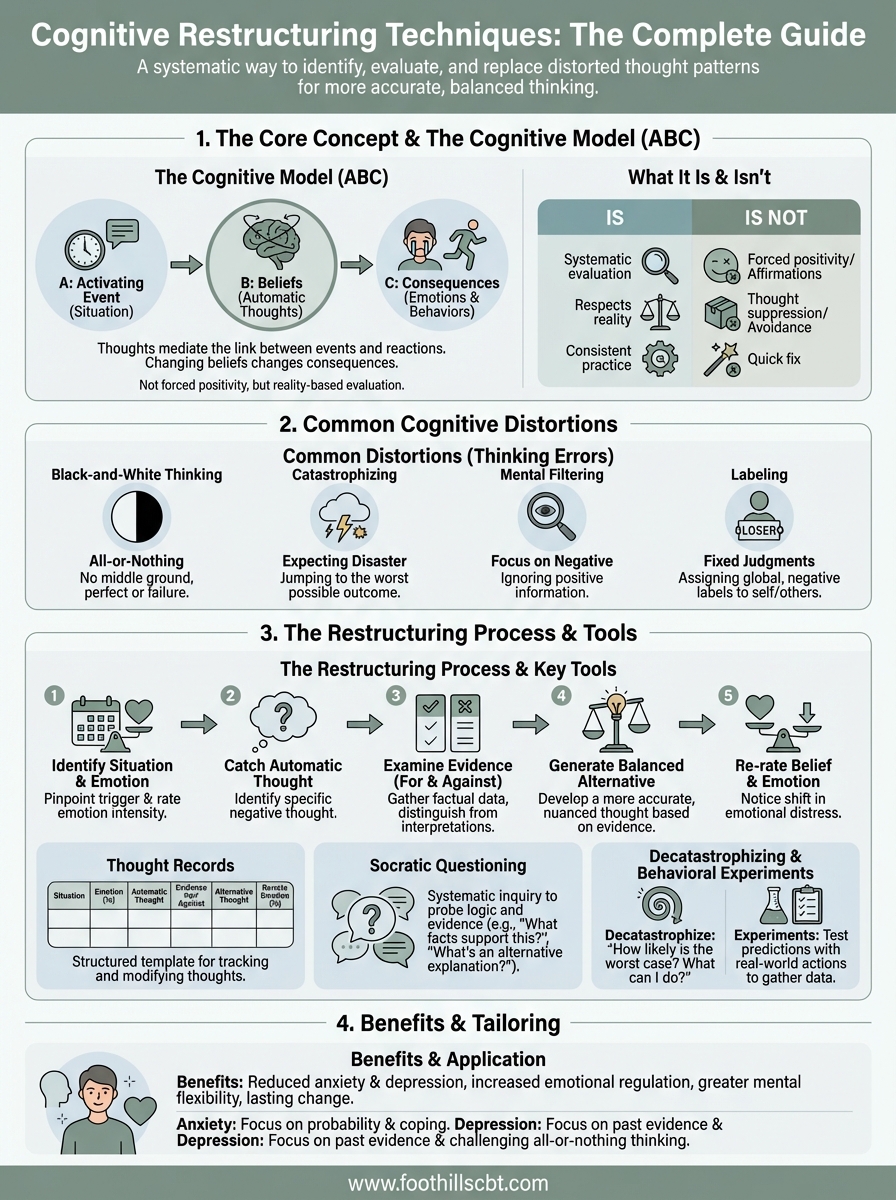
Therapists often teach the cognitive model using the ABC framework: Activating event, Beliefs, and Consequences. The activating event is any situation, internal sensation, or memory that triggers a reaction. Your beliefs represent the automatic thoughts and interpretations you form about that event, often so quickly you don't notice them occurring. The consequences include both your emotional responses and your behavioral reactions. Most people assume A directly causes C, believing situations make them feel certain ways. The cognitive model reveals that B mediates the relationship between events and outcomes.
Consider a concrete example. You send a text to a friend (A), and they don't respond for several hours. If your belief (B) is "They're angry with me," you might feel anxious and send multiple follow-up messages (C). If your belief is "They're probably busy," you feel neutral and continue with your day. The same activating event produces different consequences depending entirely on your interpretation. This framework shows you exactly where intervention needs to occur: at the belief level, where thoughts arise and shape everything that follows.
Your emotional reactions stem from how you interpret situations, not from the situations themselves, which is why cognitive restructuring techniques target those interpretations directly.
How thoughts mediate between events and emotions
The cognitive model challenges the common assumption that external circumstances control your emotional state. While severe situations naturally produce distress, much of your daily emotional experience comes from the running commentary your mind provides about what's happening. You don't just encounter events; you instantly evaluate, judge, and predict based on those events. These evaluations happen so automatically that most people confuse them with reality itself. You think "This is terrible" and experience it as a fact rather than an interpretation open to revision.
When you learn that thoughts mediate your emotional responses, you gain access to a powerful leverage point for change. You can't always control what happens to you, but you can learn to recognize and modify your interpretations. This insight explains why cognitive restructuring works: you're not trying to change reality or suppress natural reactions to genuinely difficult situations. Instead, you're correcting distortions in how you perceive what's happening, which naturally shifts your emotional response to something more appropriate and manageable. The technique addresses the actual mechanism driving unnecessary suffering.
Common cognitive distortions to watch for
Your mind uses mental shortcuts to process information quickly, but these shortcuts often produce systematic errors in thinking called cognitive distortions. These patterns twist your perception of events, making neutral or mildly negative situations feel catastrophic. You've likely experienced them countless times without recognizing them as distortions rather than accurate reflections of reality. Learning to identify these specific patterns gives you the first step toward applying cognitive restructuring techniques effectively, because you can't challenge a thought if you don't notice when your thinking has veered off course.

All-or-nothing patterns and labeling mistakes
Black-and-white thinking eliminates the middle ground, forcing everything into extreme categories. You see yourself as either a complete success or total failure, with no room for partial achievement or learning experiences. When you make one mistake at work, your mind concludes "I'm incompetent" rather than "I struggled with this specific task." This distortion creates intense emotional swings because no gray area exists to soften the blow of imperfection. You might avoid trying new activities because anything less than perfect performance feels like complete failure.
Labeling takes this pattern further by assigning global judgments to yourself or others based on single events. Instead of thinking "I acted thoughtlessly," you jump to "I'm a terrible person." The label becomes your identity rather than a description of one behavior in one moment. These fixed characterizations prevent you from seeing yourself or others as complex, changing individuals capable of growth. When you label someone as "selfish" after one interaction, you filter all their future actions through that lens, missing evidence that contradicts your conclusion.
Prediction errors and mental filters
Catastrophizing involves jumping to the worst possible outcome without considering more likely scenarios. You imagine disasters in vivid detail: a headache becomes brain cancer, a delayed response means your friendship is over, or one poor evaluation signals the end of your career. Your mind treats these extreme predictions as certain rather than recognizing them as one possibility among many. This distortion keeps you in constant fear of futures that rarely materialize, draining energy you could use to address actual problems.
Mental filtering causes you to focus exclusively on negative details while ignoring positive or neutral information. You receive ten compliments and one criticism, but only the criticism sticks in your mind. Your brain acts like a selective spotlight, illuminating everything that confirms your negative beliefs while leaving contradictory evidence in shadow. This pattern maintains depression and low self-worth because you literally cannot see the full picture, no matter how much positive data exists around you.
Recognizing these distortions doesn't make them disappear immediately, but it creates the awareness you need to start questioning whether your thoughts reflect reality or mental habits that need revision.
The step-by-step process to restructure a thought
Cognitive restructuring techniques follow a systematic sequence that moves from identifying what you're thinking to developing more accurate interpretations. You don't need to perform every step perfectly each time, but following this structure ensures you examine your thoughts thoroughly rather than accepting them at face value. The process takes practice before it feels natural, and you'll likely need to work through it deliberately at first, especially when emotions run high and your automatic thoughts feel most convincing.
Identify the triggering situation and your emotional response
You start by pinpointing the exact moment when your mood shifted. Instead of vague descriptions like "I felt bad all day," you identify a specific situation: "I felt anxious when my supervisor said she wanted to talk." The more precise you are about the activating event, the easier the remaining steps become. You also name and rate the emotion you experienced, using a 0-100 scale to measure intensity. This rating gives you a baseline to compare against after you complete the restructuring process.
Catch the automatic thought
Next, you identify the specific thought running through your mind during that situation. This step requires honest self-examination because automatic thoughts often flash by so quickly you barely notice them. You ask yourself: "What was going through my mind right when I felt that emotion?" The answer might be "She's going to fire me" or "I did something wrong." You write down the exact words your mind produced, not a sanitized version of what you think you should have been thinking.
Examine the evidence for and against
You now gather concrete facts that support and contradict your automatic thought. For evidence supporting "She's going to fire me," you might note that performance reviews happen soon. For evidence against, you list that your recent projects received praise and your supervisor schedules regular check-ins with everyone. This step requires you to distinguish facts from interpretations, recording only what you can verify rather than other automatic thoughts disguised as evidence.
Generate and rate alternative thoughts
Based on the evidence you've collected, you develop a more balanced interpretation that accounts for all available information. Instead of "She's going to fire me," you might conclude "She probably wants to discuss upcoming projects, like she does every month." You then rate your belief in both the original thought and the new alternative, along with the intensity of your emotional response. Most people notice that their distress decreases when they've truly considered a more accurate perspective.
The restructuring process transforms thoughts from automatic reactions you believe without question into interpretations you evaluate deliberately and revise when needed.
How to use a thought record in real life
A thought record provides a structured template for practicing cognitive restructuring techniques outside of therapy sessions. You use this tool whenever distressing emotions arise, documenting your thoughts in real time or shortly afterward while details remain fresh. The format typically includes columns for the situation, emotions, automatic thoughts, evidence, and alternative perspectives, walking you through the restructuring process systematically. This written approach prevents you from skipping steps or letting your mind wander away from difficult material when you most need to examine it carefully.

Thought records transform an abstract skill into something concrete and repeatable. Instead of trying to challenge thoughts mentally while emotions overwhelm you, you follow a clear framework that guides your attention through each necessary step. The act of writing itself creates psychological distance from intense feelings, allowing you to analyze your thinking patterns more objectively than you could through mental review alone.
The basic format of a thought record
Most thought records divide your analysis into five to seven columns that move from identifying what happened to developing balanced alternatives. You start by describing the triggering situation in one or two sentences, noting exactly when and where the event occurred. The next column captures your emotional response, both the name of each emotion and its intensity rated from 0 to 100. You then record the automatic thought that arose during that moment, writing it exactly as it appeared in your mind without editing or softening the language.
The middle columns focus on evidence, with separate spaces for facts supporting and contradicting your automatic thought. You list only verifiable information here, not additional thoughts or assumptions. Finally, you generate an alternative thought based on the evidence you've gathered, rate your belief in both thoughts, and reassess your emotional intensity. Some templates add a column for action steps or behavioral responses, helping you connect thought changes to concrete decisions.
When to complete a thought record
You practice this technique when your emotional intensity exceeds what the situation warrants, signaling that distorted thinking might be driving your reaction. The best time to complete a thought record is within a few hours of the triggering event, while you still remember specific details and can accurately identify your thoughts. Waiting days later reduces the exercise to speculation rather than genuine examination of what actually occurred in your mind.
Many therapists assign thought records as homework between sessions, asking you to complete two or three each week. You don't need to document every negative thought that crosses your mind. Instead, you focus on significant emotional reactions or recurring patterns you've identified with your therapist as targets for change.
Regular practice with thought records builds the cognitive restructuring skill until questioning automatic thoughts becomes second nature, requiring less deliberate effort over time.
A practical example of completing a record
Consider someone who receives a text from their partner saying "We need to talk." In the situation column, they write the exact message and time they received it. For emotions, they record anxiety at 85 and fear at 70. Their automatic thought reads: "They're going to break up with me." Under evidence supporting this thought, they might note that their partner seemed distant yesterday. Evidence against includes that they made plans together for next month, their partner says this phrase often before discussing household logistics, and their relationship has been stable recently.
The alternative thought becomes: "They probably want to discuss something practical or schedule-related, like they usually do." They rate belief in the original thought dropping from 90 to 30, and anxiety decreasing from 85 to 40. This example shows how systematically examining evidence shifts both beliefs and emotional responses without forcing positivity or denying genuine concerns.
How to use Socratic questioning to challenge thoughts
Socratic questioning takes its name from the ancient Greek philosopher who taught by asking questions rather than stating answers directly. In cognitive restructuring techniques, you apply this same method to examine your automatic thoughts systematically, using specific questions that probe the logic, evidence, and consequences of what you believe. Instead of accepting thoughts as truth or trying to dismiss them forcibly, you investigate them like a detective examining a case, looking for holes in reasoning and alternative explanations you might have overlooked.
This approach works particularly well when your automatic thoughts feel absolutely true and you struggle to see any other perspective. The questions create structured doubt that opens space for reconsideration without requiring you to immediately generate a replacement thought. You guide yourself through a logical evaluation process, letting conclusions emerge from the evidence rather than forcing predetermined answers.
The core questions therapists ask
Therapists use several standard questions that you can learn to ask yourself whenever distorted thinking appears. You start with evidence-based questions: "What facts support this thought? What facts contradict it?" These prompts force you to distinguish actual evidence from assumptions you're treating as proven. You then explore alternative explanations: "What are other ways to interpret this situation? What would I tell a friend who had this thought?" This perspective-shifting reveals interpretations you missed while caught in your initial reaction.
Additional questions target the practical implications of maintaining your belief: "If this thought is true, what's the worst that could happen? How likely is that outcome? How have I handled similar situations before?" You also examine the effect of holding the thought: "What does believing this cost me? How does it change my behavior?" These questions expose whether your thought serves you or keeps you stuck in unnecessary distress.
Socratic questioning transforms you from a passive recipient of automatic thoughts into an active investigator who evaluates whether those thoughts deserve belief.
How to apply questions to a specific thought
Consider the automatic thought "I'm boring and nobody wants to talk to me" after a quiet gathering. You begin questioning: "What evidence supports this? I didn't initiate many conversations." Then you examine contradictions: "What evidence goes against it? Several people approached me, and one person asked for my contact information." You explore alternatives: "What else might explain the quiet evening? I felt tired and withdrew, or the group dynamics were already established before I arrived."
You then assess consequences: "If this thought is true, how would I verify it? What have past social experiences shown me?" This systematic examination reveals that your evidence comes mostly from your internal experience of discomfort, not from others' actual responses. The questioning process doesn't require you to conclude "I'm fascinating," but it does expose that "I'm boring and nobody wants to talk to me" rests on weak evidence and ignores contradictory data. This recognition naturally loosens the thought's grip without forcing positive thinking.
How to decatastrophize and reduce what-if spirals
Catastrophizing pulls your mind toward worst-case scenarios that feel inevitable even when they're highly unlikely. You imagine disasters in vivid detail, treating remote possibilities as certainties: a cough becomes lung disease, a critical email means job loss, or a relationship disagreement signals imminent breakup. These thoughts often trigger what-if spirals, where your mind chains one catastrophic prediction to another in an endless loop. Decatastrophizing techniques, a specific application of cognitive restructuring techniques, help you evaluate these predictions realistically and interrupt the spiral before it consumes your attention and energy.
The decatastrophizing question sequence
You begin by identifying the specific catastrophe your mind predicts and writing it down exactly as you imagine it. Then you ask yourself: "What's the worst that could realistically happen?" Notice the word realistically, you're not asking for the absolute worst scenario your imagination can produce, but rather the most negative outcome that genuinely might occur based on available evidence. This question alone often reveals that your initial catastrophe involved several improbable events happening simultaneously.
Next, you evaluate likelihood: "How probable is this worst-case outcome?" You assign a percentage based on facts, not feelings. Your anxiety might scream 90 percent, but examining similar situations from your past often shows actual rates closer to 5 or 10 percent. You then explore middle-ground possibilities: "What are more likely outcomes?" This step populates your mind with realistic scenarios that your catastrophic thinking overlooked entirely. Most situations land somewhere between best and worst case, but catastrophizing blinds you to that middle territory.
Finally, you assess your ability to cope: "If the worst did happen, how would I handle it? What resources could I use? How have I managed difficult situations before?" This question shifts your focus from prevention to preparation, reducing the sense of helplessness that fuels catastrophic thinking.
Decatastrophizing doesn't minimize real problems, but it prevents you from treating low-probability disasters as guaranteed outcomes that warrant immediate panic.
Breaking what-if chains before they spiral
What-if thinking creates a mental domino effect where one negative prediction triggers another, each building on the last until you've constructed an elaborate disaster scenario. You stop this pattern by recognizing when a what-if thought appears and refusing to answer it with another catastrophic prediction. Instead, you redirect: "I notice I'm asking what-if questions. What do I actually know right now?" This grounds you in present facts rather than imagined futures, cutting the spiral at its source before it gains momentum.
How to use behavioral experiments to test beliefs
Behavioral experiments move cognitive restructuring techniques beyond verbal analysis into real-world testing. Instead of debating whether your thoughts are accurate, you design structured tests that generate actual evidence. You treat your automatic thoughts as hypotheses to investigate rather than facts to accept. This approach works particularly well when you hold strong predictions about outcomes that keep you avoiding situations or maintaining rigid behavioral patterns. The experiment provides concrete data that either confirms or contradicts what you believe will happen.

Designing an experiment to test a specific belief
You start by identifying a testable prediction from your automatic thought. Instead of vague beliefs like "People don't like me," you extract a specific, measurable hypothesis: "If I speak up in the team meeting, my coworkers will ignore my ideas." The prediction must be concrete enough that you can observe whether it actually occurs. You then plan exactly what you'll do to test it, including when, where, and how you'll conduct the experiment. Writing down your prediction before the experiment prevents your mind from rewriting history afterward.
Your experimental design should start small, testing your belief in a lower-stakes situation before moving to more anxiety-provoking scenarios. You might begin by sharing one comment in a meeting rather than presenting a full proposal. This graduated approach lets you gather data systematically while building confidence through manageable steps.
Running the experiment and collecting data
During the experiment, you focus on observing what actually happens rather than monitoring your internal anxiety. You notice specific responses: how many people responded to your comment, what they said, their facial expressions, and whether the conversation continued. You record these observations as soon as possible after the experiment ends, before your memory becomes influenced by your beliefs. Writing down concrete facts creates a record you can review objectively later.
Behavioral experiments transform abstract beliefs into testable predictions, replacing speculation with actual evidence about how situations unfold.
Evaluating results and comparing predictions
After completing your experiment, you compare your original prediction against actual outcomes. You ask yourself: "What did I predict would happen? What actually occurred? How do I explain the difference?" Often, you discover that your catastrophic predictions didn't materialize, or that negative outcomes were less severe than anticipated. You then update your belief based on the evidence, rating how strongly you now hold the original thought. Repeating experiments across multiple situations builds a robust dataset that either confirms or challenges your assumptions, leading to belief change grounded in your own direct experience rather than theoretical arguments.
How to tailor techniques for common concerns
Cognitive restructuring techniques work across many conditions, but different mental health challenges require specific adjustments in how you apply the basic process. Someone with anxiety focuses on different thought patterns than someone with depression, and the questions you ask yourself change depending on which distortions dominate your thinking. You don't need to master separate techniques for each concern. Instead, you modify the standard restructuring process to target the particular beliefs and predictions that fuel your specific symptoms. Understanding these adaptations helps you direct your cognitive work where it will create the most meaningful change.
Adapting restructuring for anxiety disorders
Anxiety drives you to overestimate threats and underestimate your ability to cope, so your restructuring work emphasizes probability assessment and coping resources. You focus heavily on the decatastrophizing questions covered earlier, repeatedly asking "How likely is this outcome?" rather than treating anxious predictions as certainties. Your thought records should include a column specifically for rating the probability of feared outcomes before and after examining evidence, making this explicit evaluation a standard part of your process.
When working with social anxiety, you target mind-reading thoughts and assumptions about others' judgments. Your alternative thoughts acknowledge that you cannot know what others think without direct evidence, and you design behavioral experiments that test social predictions rather than avoiding situations entirely. For panic disorder, you restructure catastrophic interpretations of physical sensations, gathering evidence about what your racing heart or shortness of breath actually means versus the disaster your mind predicts.
Anxiety-focused restructuring emphasizes probability over possibility, training your mind to evaluate how likely outcomes are rather than simply whether they could occur.
Modifying techniques for depression
Depression generates thoughts about worthlessness, hopelessness, and permanent failure that require past-focused evidence gathering. Your thought records include sections examining times you succeeded, moments you felt differently, and periods when predictions of permanent despair proved false. You pay particular attention to all-or-nothing thinking and mental filtering, since depression narrows your attention to negative information while blocking access to contradictory evidence.
You might add a gratitude or positive data log alongside your thought records, deliberately documenting neutral or pleasant experiences that your depressive filter typically excludes. This doesn't mean forcing positivity, but rather correcting the systematic bias depression creates in what you notice and remember. Your alternative thoughts acknowledge genuine difficulties while challenging the global, permanent interpretations depression produces. Instead of restructuring "I failed" to "I succeeded," you might develop "I struggled with this specific task, and I can learn from what happened."
Next steps
You now have a complete framework for applying cognitive restructuring techniques to the thoughts that drive your distress. The process requires consistent practice, not occasional effort when you remember. You'll build the skill gradually by working through thought records when emotions spike, using Socratic questions to examine your automatic interpretations, and designing behavioral experiments that test what you believe against what actually happens. Change accumulates through repetition, transforming restructuring from a deliberate exercise into an automatic response you apply without conscious effort.
Most people benefit from professional guidance as they develop these skills, particularly when addressing anxiety disorders, depression, or trauma-related conditions that involve deeply entrenched thought patterns. Working with a therapist who specializes in evidence-based cognitive approaches accelerates your progress and helps you navigate the moments when challenging your thoughts feels impossible. If you're located in Colorado and want support applying these techniques to your specific concerns, Foothills CBT in Boulder provides cognitive behavioral therapy with PhD-level psychologists who use these methods daily in their clinical practice.